- English
- Español
- Português
- русский
- Français
- 日本語
- Deutsch
- tiếng Việt
- Italiano
- Nederlands
- ภาษาไทย
- Polski
- 한국어
- Svenska
- magyar
- Malay
- বাংলা ভাষার
- Dansk
- Suomi
- हिन्दी
- Pilipino
- Türkçe
- Gaeilge
- العربية
- Indonesia
- Norsk
- تمل
- český
- ελληνικά
- український
- Javanese
- فارسی
- தமிழ்
- తెలుగు
- नेपाली
- Burmese
- български
- ລາວ
- Latine
- Қазақша
- Euskal
- Azərbaycan
- Slovenský jazyk
- Македонски
- Lietuvos
- Eesti Keel
- Română
- Slovenski
- मराठी
- Srpski језик

Can a Four-in-One Gas Detector Measure Oxygen Deficiency? Is It Suitable for All Oxygen-Deficient Scenarios?
In confined spaces such as underground tunnels, storage facilities, and other work environments, limited ventilation or poor air circulation often leads to the risk of oxygen deficiency. Once the oxygen concentration drops too low, it directly threatens the life and health of workers. As a widely used safety monitoring device in industrial settings, many frontline workers and safety managers wonder whether the four-in-one gas detector has the capability to detect oxygen deficiency and whether it can adapt to various complex oxygen-deficient scenarios. Let's have ZeChuan Technology's editor answer these questions.
In fact, most four-in-one gas detectors have oxygen deficiency detection capabilities, but due to the influence of key equipment configurations, sensor performance, and extreme conditions in different scenarios, they cannot adapt to all oxygen-deficient scenarios. A comprehensive judgment needs to be made based on the equipment parameters and the characteristics of the actual working environment.
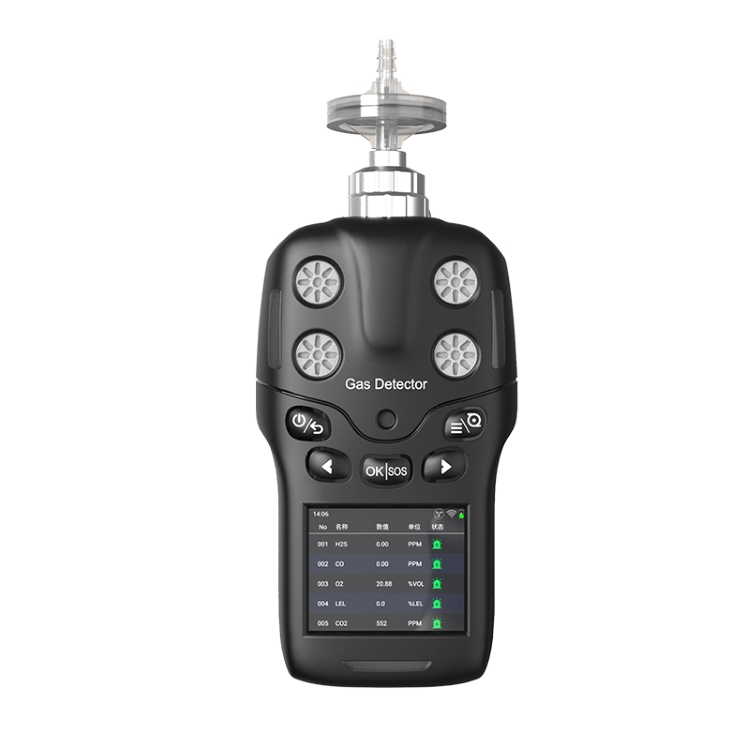
I. Conventional Four-in-One Detectors Can Detect Oxygen Deficiency
The core detection module of a conventional four-in-one gas detector usually includes an oxygen detection module, which is key to its ability to monitor oxygen deficiency. From a working principle perspective, oxygen deficiency is essentially when the oxygen concentration in the working environment is lower than the standard range required for human safety. The oxygen sensor of the four-in-one detector continuously senses the oxygen content of the surrounding environment, converting the oxygen concentration signal into a recognizable electrical signal, which is then analyzed by the device's signal processing system.
When the detected oxygen concentration is lower than the preset oxygen deficiency alarm threshold, the device will immediately trigger an audible, visual, or vibration alarm, promptly reminding on-site personnel to take safety measures such as ventilation and evacuation, thus achieving effective monitoring of oxygen deficiency.
Common industrial four-in-one detectors generally have an oxygen detection range covering 18% VOL to 23% VOL, which can accurately capture concentration changes below the critical value of 19.5% VOL for oxygen deficiency, fully meeting the monitoring needs of most ordinary oxygen-deficient scenarios, such as routine underground pipeline maintenance and work in ordinary confined storage facilities.
II. Not Suitable for All Oxygen-Deficient Scenarios
It needs to be clarified that four-in-one gas detectors are not suitable for all oxygen-deficient scenarios. In some special oxygen-deficient environments, there will be significant limitations in their applicability. For example, in extreme oxygen-deficient environments with low temperatures, high humidity, high dust levels, or strong corrosive gases, the oxygen sensor of a standard four-in-one gas detector is susceptible to environmental interference and damage. Low temperatures reduce the sensor's sensitivity, high humidity and dust can clog the sensor probe and damage the internal circuitry, and strong corrosive gases can corrode the sensor components. These factors can lead to decreased detection accuracy, data drift, and even equipment failure, preventing stable and accurate monitoring of oxygen-deficient conditions. Similarly, special oxygen-deficient scenarios such as deep-sea operations and high-altitude environments have specific requirements for the detector's pressure tolerance and detection range. The high pressure in deep-sea environments can compress the equipment casing and affect the normal operation of the sensor, while the low atmospheric pressure at high altitudes alters the physical properties of oxygen. The pressure tolerance range and detection range of conventional four-in-one gas detectors are often insufficient to meet these special needs.
Furthermore, some simplified four-in-one gas detectors, in order to control costs, may not be equipped with an oxygen detection module, only detecting major risk gases such as flammable and toxic gases. Such devices naturally lack oxygen deficiency detection capabilities, and using them in scenarios with oxygen deficiency risks would leave serious safety hazards.
III. Key Points for Selection and Use in Oxygen-Deficient Scenarios
When selecting a four-in-one gas detector for oxygen-deficient scenarios, it is crucial to carefully check the equipment parameters, confirming whether an oxygen detection module is included, and paying attention to the oxygen detection range and the sensor's environmental adaptation parameters.
Secondly, it is necessary to consider the characteristics of the specific work scenario to determine if the equipment is suitable. For example, in low-temperature and high-humidity environments, equipment with moisture and dust protection and a wide temperature adaptation range should be selected. In special scenarios such as high altitudes or deep seas, models specifically designed for extreme pressure environments should be chosen.
Additionally, during use, the oxygen sensor should be calibrated and maintained regularly to ensure stable performance and prevent inaccurate oxygen deficiency detection due to sensor aging or malfunction.
In summary, most conventional four-in-one gas detectors can meet the oxygen deficiency detection needs of ordinary scenarios, but due to equipment configuration and scenario limitations, they cannot be adapted to all oxygen-deficient scenarios. Only by selecting equipment with suitable configurations and matching environmental adaptability, and performing regular maintenance, can the effectiveness of oxygen deficiency monitoring be ensured, thus providing a strong safety net for the lives of workers.